



How to List Resume References for 2026 [+ Examples]

- Our customers have been hired by*


Resume references are professional contacts who can confirm your skills, work ethic, and performance. Employers typically request them at the final stage of hiring to verify your experience and assess cultural fit.
Knowing when and how to prepare a professional reference page ensures you’re ready when asked without cluttering your resume.
In this guide, you’ll learn when to include references, where to list them, how to ask for them, and how to format a professional reference page for 2026.
Should You Include References on a Resume?
No, you should not include references directly on your resume unless the employer specifically requests them. Most hiring managers ask for references only after interviews, once you’re a serious candidate.
Reference checks happen late in the hiring process. Including them when writing your resume wastes valuable space that could be used to highlight achievements and measurable results. Instead, prepare a separate reference page and provide it only when requested.
When Should You Include References?
You may need to list references when:
- The job posting explicitly requests them.
- The application form includes a references section.
- You’re applying for a government or academic role.
- The employer asks for references upfront.
If none of these apply, keep them off your resume.
Where Should You List References?
Resume references should live in a separate document, not on your main resume. A reference page helps keep your resume focused on what matters while ensuring you can quickly share references when requested.
Create a dedicated reference page that:
- Uses the same header as your resume (name, phone, email)
- Matches your resume’s fonts and formatting for consistency
- Lists three to five professional contacts
Who & How to Ask for Resume References
Strong references are people who can speak specifically about your performance and your character—ideally, contacts you’ve gathered in your professional life.
Who to Use as a Resume Reference
The best resume references are professionals who directly observed your work and can provide specific examples of your skills, performance, and impact. Choose individuals who understand your contributions and can confidently connect them to the job you’re pursuing.
Choose people who:
Supervised Your Work (Managers or Team Leads):
Direct supervisors are often the strongest references because they evaluated your performance, assigned responsibilities, and can speak to your work experience. They can confirm your reliability, attest to your growth, and affirm you’re able to meet expectations.
Collaborated Closely With You (Senior Colleagues):
Senior coworkers or cross-functional partners can highlight your teamwork skills, communication, and project contributions. A reference from a senior colleague is especially helpful if you worked on high-impact initiatives or led collaborative efforts.
Mentored You in Professional or Academic Settings:
Mentors, professors, or internship supervisors are excellent references for early-career professionals. They can speak to your work ethic, initiative, technical skills, and growth potential.
Can Discuss Skills Relevant to the Job You’re Applying for:
As a general rule, always prioritize relevance over seniority. A mid-level manager who can describe your leadership on a key project is more valuable than a high-level executive who barely worked with you.
Early-career professionals typically need three references. Senior or executive candidates may provide four to five references representing different stages of their career and leadership progression.
Avoid listing:
Friends or Family Members:
Personal relationships lack professional credibility and may raise red flags for hiring managers.
Anyone Who Can't Speak Positively About Your Work:
If there’s uncertainty about what someone might say, do not include them. References should reinforce your strengths, not create doubt.
Contacts You Haven’t Spoken to in Years:
Outdated references may provide vague or inaccurate information. Reconnect first to confirm they’re comfortable and informed about your recent experience.
How to Ask Someone to Be a Reference in 6 Steps
Always get someone’s approval before adding them to your reference list. When a reference knows an employer may contact them and understands the role you’re pursuing, they can provide more specific and impactful feedback, which can positively affect the employer’s final decision.
Follow these steps to make your reference request as professional as possible:
1. Reach Out Personally
Contact potential references by email or phone rather than sending a quick text. A short, professional message shows respect and gives them space to decline if needed.
2. Explain the Role You’re Applying For
Share the job title, company, and why you’re excited about the opportunity. Context helps them tailor their comments to what the employer values.
3. Share Your Updated Resume
Send your current resume and, if possible, the job description. Sharing these documents refreshes their memory and aligns their feedback with your most relevant accomplishments.
4. Highlight Key Skills or Projects
Briefly remind them of projects you worked on together or results you achieved. For example: “You supervised the product launch where we increased revenue by 18%.” This little note helps them make their recommendation more detailed and credible.
5. Confirm Contact Details and Availability
Verify their preferred phone number and email. Ask if they’re comfortable being contacted within a certain timeframe.
6. Follow Up With Appreciation
Thank them after they agree, and update them if you land the role. Maintaining the relationship strengthens your long-term professional network.
Giving advance notice allows your reference to prepare thoughtful, specific examples, which are far more persuasive than generic praise.
Giving advance notice allows your reference to prepare thoughtful, specific examples, which are far more persuasive than generic praise.
How to Format a Professional References Page
A professional reference page should be simple and easy to scan so hiring managers can quickly find contact information. Your goal is clarity, so no need for design flourishes. Just maintain a polished, professional appearance that matches your resume and cover letter.
Start by placing your name and contact information at the top, formatted exactly like your resume header. Consistency between documents keeps your application cohesive and ensures your reference sheet looks intentional rather than an afterthought.
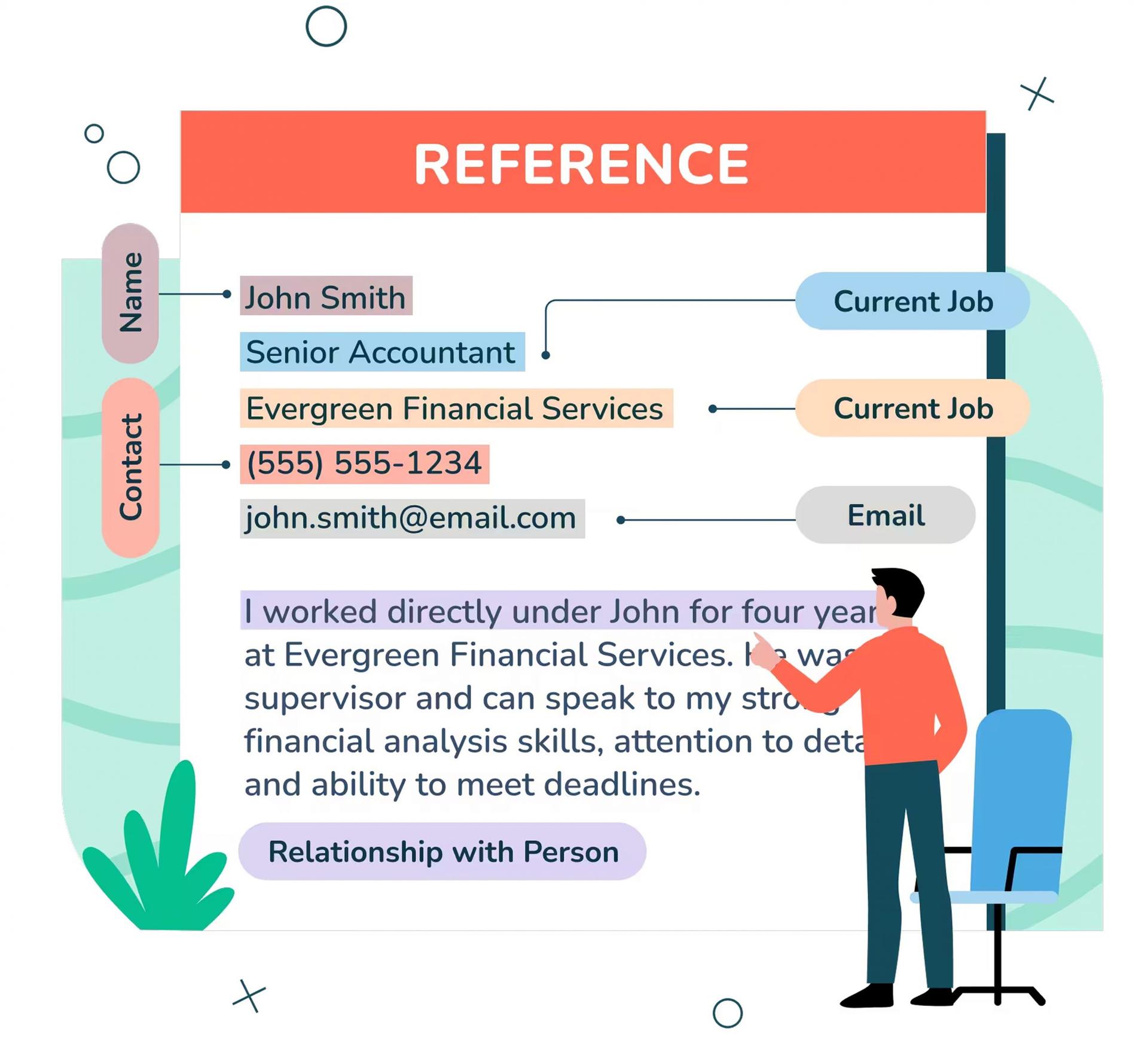
Immediately list each reference using this format:
- Full name
- Current job title
- Company name
- Phone number
- Professional email
- One-sentence description of your relationship
Follow Formatting Best Practices
A well-structured reference page should:
- Use the same font style and size as your resume.
- Maintain consistent spacing between each reference.
- Avoid graphics, icons, or decorative elements.
- Include three to five references, depending on your experience level.
- Be saved as a separate document (i.e., “FirstName_LastName_References”).
What to Include in Your Description Sentence
Your one-sentence description should briefly explain your professional relationship with the reference (i.e., direct supervisor, team lead, mentor). Establish how long you worked together, and mention one or two relevant skills or strengths they can confirm.
“Direct supervisor for three years; can speak to my project leadership, client communication skills, and ability to deliver results under tight deadlines.”
Avoid writing full paragraphs or overly general statements like “Knows me well.” Specific, skill-focused descriptions make your references more credible and useful to employers.
Jane Doe
Director of Marketing
Evergreen Funnels
(555) 555-5555
jane.doe@email.com
Direct manager for five years; can speak to my campaign development, performance metrics tracking, and market research skills.
Resume References Examples
Use these examples to get started on your resume references list:
John Smith
Senior Accountant
Evergreen Financial Services
(555) 555-1234
john.smith@email.com
Direct supervisor for four years; can speak to my financial analysis skills, attention to detail, and ability to meet strict deadlines.
Sarah González
Controller
Pinnacle Financial Solutions, LLC
(555) 555-5678
sarah.gonzalez@email.com
Collaborated for three years on financial reporting projects; can confirm my budgeting expertise and strategic insight.
Michael Davis
Auditor
Smith & Associates, LLP
(555) 555-9012
michael.davis@email.com
Mentor for two years; can verify my audit procedures, risk assessment skills, and commitment to ethical reporting.
Key Takeaways
1. Don't Include References in a Resume
Only include references directly on your resume if requested by the employer. It’s best to save space for relevant accomplishments and skills.
2. Submit a References Page
Prepare a separate reference page in advance in case employers request it. Share three to five trusted contacts.
3. Choose References Carefully
Choose supervisors or colleagues as references who can speak to your relevant skills.
4. Ask Permission Before Listing a Reference
A polite check-in with a potential reference is cordial and helps the reference be prepared when contacted.
5. Format Each Reference Consistently
Include name, job details, phone number, email, and a brief statement about your relationship with them.
FAQ
In what order should you list your references?
List your references in order of relevance and impact. Start with the person most closely connected to the job you’re applying for, typically a direct supervisor. Prioritize recent and senior contacts who can provide detailed insights into your performance.
What are the best types of professional references?
The best references are former managers, supervisors, or senior colleagues who directly oversaw your work. Academic advisors are appropriate for recent graduates. Choose individuals who can provide specific examples of your achievements, reliability, and job-related skills.
Who cannot be used as a reference?
You should not use friends, family members, or anyone who cannot professionally evaluate your work. Avoid listing coworkers without supervisory insight or individuals you haven’t contacted recently. Every reference should be prepared to give a clear and positive recommendation.

